
Video Chat Template
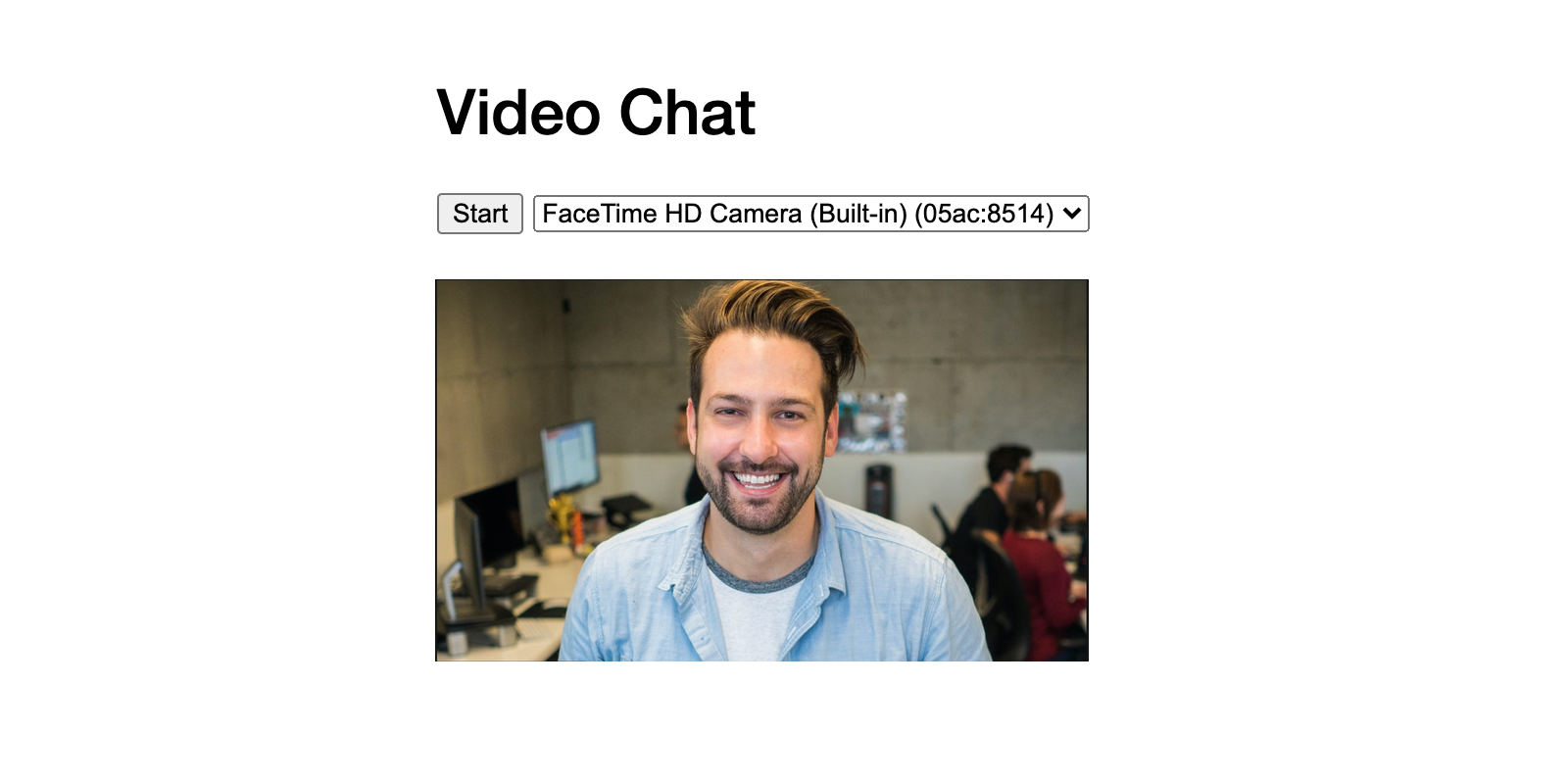
This template creates a minimal video chat between the visitors of the site. It uses the Peersockets API to set up a WebRTC video call between users. Traffic is encrypted so that only users who possess the site’s URL can read it.
(Note: this is a simple demo and won’t work with more than 2 users.)
Source
Section titled “Source”<!doctype html><html> <head> <link rel="icon" type="image/png" sizes="32x32" href="/thumb.png"> <style> body { margin: 20px; font-family: 'Segoe UI', Roboto, Oxygen, Ubuntu, Cantarell, 'Open Sans', 'Helvetica Neue', sans-serif; } h1 { font-weight: 500; } #videos { display: grid; grid-template-columns: 1fr 1fr; grid-gap: 10px; margin: 10px 0; } video { width: 100%; } </style> </head> <body> <h1>Video Chat</h1> <button id="startButton">Start</button> <select id="videoSelect"></select> <select id="audioSelect"></select> <div id="videos"> <video id="localVideo" playsinline autoplay muted></video> <video id="remoteVideo" playsinline autoplay></video> </div> </body>
<script>var peerSockets = new Set()var topicvar localStream;var peerConnection;var uuid;var videoDevice;var audioDevice;
var peerConnectionConfig = { 'iceServers': [ {'urls': 'stun:stun.stunprotocol.org:3478'}, {'urls': 'stun:stun.l.google.com:19302'}, ]};
async function pageReady() { console.log('running setup') uuid = createUUID();
var peerEvents = nomad.peersockets.watch() peerEvents.addEventListener('join', e => { console.log('join', e) peerSockets.add(e.peerId) }) peerEvents.addEventListener('leave', e => { console.log('leave', e) peerSockets.delete(e.peerId) }) topic = nomad.peersockets.join('signalling') topic.addEventListener('message', gotMessageFromPeersocket)
navigator.mediaDevices.getUserMedia({video: true, audio: true}).then(getUserMediaSuccess).catch(errorHandler);
try { var devices = await navigator.mediaDevices.enumerateDevices() for (let device of devices) { let opt = document.createElement('option') opt.value = device.deviceId opt.textContent = device.label if (device.kind === 'videoinput') { videoSelect.append(opt) } else if (device.kind === 'audioinput') { audioSelect.append(opt) } } videoSelect.addEventListener('change', onChangeDevice) audioSelect.addEventListener('change', onChangeDevice) } catch (e) { videoSelect.remove() audioSelect.remove() }
console.log('setup finished')}
function onChangeDevice () { navigator.mediaDevices.getUserMedia({video: {deviceId: videoSelect.value}, audio: {deviceId: audioSelect.value}}).then(getUserMediaSuccess).catch(errorHandler);}
function sendToAllPeersockets (message) { console.log('sent', {message}) message = new TextEncoder('utf-8').encode(JSON.stringify(message)) for (let peer of peerSockets) { topic.send(peer, message) }}
function getUserMediaSuccess(stream) { localStream = stream; localVideo.srcObject = stream;}
function start(isCaller) { peerConnection = new RTCPeerConnection(peerConnectionConfig); peerConnection.onicecandidate = gotIceCandidate; peerConnection.ontrack = gotRemoteStream; peerConnection.addStream(localStream);
if(isCaller) { peerConnection.createOffer().then(createdDescription).catch(errorHandler); }}startButton.addEventListener('click', start)
function gotMessageFromPeersocket({peerId, message}) { console.log('received', {peerId, message}) if(!peerConnection) start(false);
var signal = JSON.parse(new TextDecoder().decode(message));
// Ignore messages from ourself if(signal.uuid == uuid) return;
if(signal.sdp) { peerConnection.setRemoteDescription(new RTCSessionDescription(signal.sdp)).then(function() { // Only create answers in response to offers if(signal.sdp.type == 'offer') { peerConnection.createAnswer().then(createdDescription).catch(errorHandler); } }).catch(errorHandler); } else if(signal.ice) { peerConnection.addIceCandidate(new RTCIceCandidate(signal.ice)).catch(errorHandler); }}
function gotIceCandidate(event) { if(event.candidate != null) { sendToAllPeersockets({'ice': event.candidate, 'uuid': uuid}); }}
function createdDescription(description) { console.log('got description');
peerConnection.setLocalDescription(description).then(function() { sendToAllPeersockets({'sdp': peerConnection.localDescription, 'uuid': uuid}); }).catch(errorHandler);}
function gotRemoteStream(event) { console.log('got remote stream'); remoteVideo.srcObject = event.streams[0];}
function errorHandler(error) { console.log(error);}
// Taken from http://stackoverflow.com/a/105074/515584// Strictly speaking, it's not a real UUID, but it gets the job done herefunction createUUID() { function s4() { return Math.floor((1 + Math.random()) * 0x10000).toString(16).substring(1); }
return s4() + s4() + '-' + s4() + '-' + s4() + '-' + s4() + '-' + s4() + s4() + s4();}
pageReady() </script></html>MIT License
Copyright (c) 2020 Blue Link Labs
Permission is hereby granted, free of charge, to any person obtaining a copyof this software and associated documentation files (the "Software"), to dealin the Software without restriction, including without limitation the rightsto use, copy, modify, merge, publish, distribute, sublicense, and/or sellcopies of the Software, and to permit persons to whom the Software isfurnished to do so, subject to the following conditions:
The above copyright notice and this permission notice shall be included in allcopies or substantial portions of the Software.
THE SOFTWARE IS PROVIDED "AS IS", WITHOUT WARRANTY OF ANY KIND, EXPRESS ORIMPLIED, INCLUDING BUT NOT LIMITED TO THE WARRANTIES OF MERCHANTABILITY,FITNESS FOR A PARTICULAR PURPOSE AND NONINFRINGEMENT. IN NO EVENT SHALL THEAUTHORS OR COPYRIGHT HOLDERS BE LIABLE FOR ANY CLAIM, DAMAGES OR OTHERLIABILITY, WHETHER IN AN ACTION OF CONTRACT, TORT OR OTHERWISE, ARISING FROM,OUT OF OR IN CONNECTION WITH THE SOFTWARE OR THE USE OR OTHER DEALINGS IN THESOFTWARE.